
Desserts
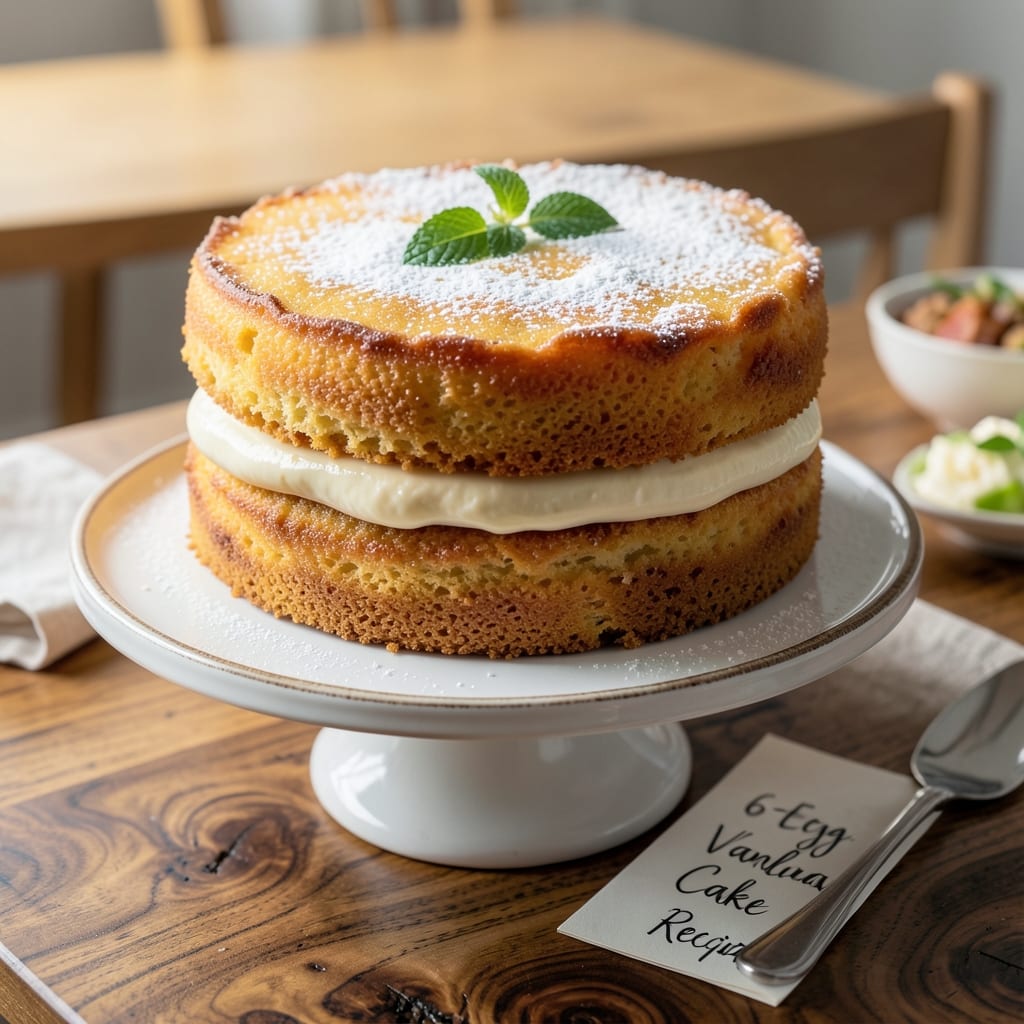
This 6-egg vanilla cake recipe delivers layers so moist they practically ooze with flavor—no dry crumb in sight. The secret lies in the perfect ratio of eggs to butter, creating a tender crumb that stays fresh for days. I developed this recipe after years of testing, ensuring every slice is light yet rich, with that signature buttery vanilla taste you crave. The technique is straightforward: whisk eggs and sugar until pale and thick, then fold in melted butter and flour for a velvety batter. Baking at 350°F for 30-35 minutes yields golden layers that hold their shape perfectly. The buttery vanilla frosting ties everything together, adding another layer of indulgence that makes this cake a showstopper. What sets this apart is the moisture retention—no greasing the pan required, and no risk of cracking. The frosting, made with just powdered sugar, butter, and vanilla, is thick enough to pipe but light enough to let the cake shine. Each bite delivers that perfect balance of tender crumb and creamy frosting. Perfect for birthdays, celebrations, or simply treating yourself. The recipe scales easily, and leftovers stay fresh for up to 3 days when stored properly. Let's get baking!
Ingredients for 6 egg vanilla cake
Six eggs, two cups sugar, and the secret to layers that stay moist for days—here's your dream cake lineup.
| Ingredient | Amount | Notes |
|---|---|---|
| Large Eggs 🥚 | 6 whole | Room temperature for best blending |
| Granulated Sugar 🍚 | 2 cups | Superfine preferred for smooth texture |
| Unsalted Butter 🧈 | 1 ½ cups | Cold, cubed for easier folding |
| All-Purpose Flour 🌾 | 2 ½ cups | Sifted for lightest crumb |
| Pure Vanilla Extract 🍯 | 2 tbsp | Bourbon-infused for depth |
| Baking Powder 🍞 | 1 ½ tsp | Freshly measured for lift |
| Salt 🧂 | ½ tsp | Fine sea salt preferred |
| Whole Milk 🥛 | ½ cup | Room temperature for blending |
| Powdered Sugar 🍚 | 3 cups | Confectioners' sugar, sifted |
| Vanilla Bean Paste 🍯 | 1 tbsp | For intense vanilla flavor |
| Vegetable Oil 🫒 | ¼ cup | Light, neutral flavor |
The eggs are non-negotiable here—room temperature makes all the difference for that pale, ribbon-like consistency. Grab the largest eggs you can find—they yield more volume. For the butter, Land O'Lakes unsalted or Plugrá are my go-tos, but any good-quality brand works. The vanilla? Bourbon-infused extract adds that extra depth, but pure vanilla will do in a pinch. Pro tip: measure your flour by weight if you can—2.5 cups by volume is about 10.5 oz, but scales are more precise. The baking powder needs to be fresh—if it's over a year old, the lift will suffer.
No vanilla bean paste? Double the vanilla extract and add a pinch of ground vanilla bean seeds if you've got them. Running low on powdered sugar? Sift granulated sugar with 1 tbsp cornstarch for a close substitute. The vegetable oil keeps the frosting tender—Mazola or Crisco work perfectly. For a lighter cake, consider adding 1 tbsp lemon juice to the batter. And if you're worried about cracking, don't overmix the batter after adding the flour—just fold until combined. The frosting can be made a day ahead and stored in the fridge—it actually tastes better after the flavors meld.
Store the cake layers in an airtight container between layers of parchment paper for up to 3 days at room temperature. The frosting? Keep it in a sealed container in the fridge for 5 days or freeze for 3 months. To assemble, let the cake layers and frosting come to room temperature first—this makes piping and layering so much easier. If you're making this ahead for a party, assemble the cake 4 hours before serving so the frosting can set properly. Trust me, the wait is worth it for that perfect slice.
Why You'll Love This Recipe
- No Mixer Needed: I swear by this recipe when my stand mixer’s on strike—just cream butter and sugar by hand until fluffy (yes, it’s work, but those six eggs do the heavy lifting). The butter’s rich enough to cut through flour easily, and the eggs bind everything together without a single whisk mark.
- Vanilla Bomb: That pure vanilla extract? It’s the star. The eggs make the crumb tender but sturdy enough to soak up the flavor, and the sugar caramelizes just enough to give every bite a subtle, warm sweetness. Honestly, it’s the kind of cake that makes store-bought boxes look sad.
- Pantry Magic: Six eggs mean fewer cakes per batch, but more flavor per slice—and less waste. Butter and sugar are staples, so I’m rarely scrambling for ingredients. Plus, leftovers? They stay moist for days, so I can bake once and enjoy twice without a second thought.
Step-by-step instructions for ultra-moist vanilla cake
This method guarantees tender, ultra-moist layers with a perfect crumb every single time.
Cream Butter, Sugar, and Eggs for Maximum Moisture
In a stand mixer fitted with the paddle attachment, beat the 1.5 cups unsalted butter (cold and cubed) and 2 cups granulated sugar on medium speed for 3-4 minutes until light and fluffy. The mixture should nearly double in volume and become pale in color. This creaming process incorporates air, which creates that signature tender crumb.
Add the 6 whole large eggs one at a time, mixing on low speed for 30 seconds after each addition until fully incorporated. Scrape down the sides of the bowl as needed to ensure even blending. I always use room-temperature eggs for this step—they blend more smoothly and create a lighter batter. The reason we add eggs gradually is to prevent the mixture from becoming too thick too quickly, which can lead to dense cake layers.
Combine Dry Ingredients and Alternate with Milk
In a separate bowl, whisk together the 2.5 cups all-purpose flour, 1.5 teaspoons baking powder, and 0.5 teaspoon salt. Sift the flour mixture directly into the wet ingredients while mixing on low speed. This prevents gluten development, which keeps the cake tender rather than chewy.
With the mixer still running on low speed, add the 0.5 cup whole milk in a slow, steady stream. Mix just until combined—you should still see a few flour streaks. Then, add the 2 tablespoons pure vanilla extract and 1 tablespoon vanilla bean paste, mixing for another 10 seconds until evenly distributed. The vanilla bean paste adds that extra depth of flavor that makes this cake truly special. Don't overmix here; the moment the flour disappears is the moment to stop.
Fold in Vegetable Oil for Extra Tenderness
Remove the bowl from the mixer and gently fold in the 0.25 cup vegetable oil using a silicone spatula. The oil coats the flour proteins, further enhancing moisture retention and creating that ultra-tender crumb. Fold just until the oil is evenly distributed—no need to overwork the batter.
At this point, the batter should be smooth, thick, and slightly shiny. If it looks too thick, you can add an extra 1-2 tablespoons of milk to reach the perfect consistency. This is your final chance to adjust before baking, so take a moment to ensure everything is well incorporated. The batter should be just thick enough to hold its shape when dropped from a spoon but still flow smoothly.
Bake in Two Layers for Even Cooking
Preheat your oven to 350°F and grease two 9-inch round cake pans with butter or line them with parchment paper. Divide the batter evenly between the two pans, filling each about ⅔ full. Tap the pans gently on the counter to remove any air bubbles.
Bake for 25-30 minutes, or until a toothpick inserted into the center comes out clean. The edges should be golden brown, but the top might still look slightly underdone—this is normal. Rotate the pans halfway through baking for even cooking. Overbaking is the enemy of moisture, so keep a close eye on them in the last few minutes. The cake should spring back when pressed gently in the center.
Cool and Prepare for Frosting
Allow the cakes to cool in their pans for 10 minutes, then transfer them to a wire rack to cool completely. This gradual cooling prevents cracking. Once fully cooled, level the tops if necessary using a serrated knife. The cakes should be moist but not sticky to the touch.
While the cakes cool, prepare the frosting by beating the 1.5 cups unsalted butter (softened) and 3 cups powdered sugar together until light and fluffy. Add the 2 tablespoons pure vanilla extract and 1 tablespoon vanilla bean paste, mixing until smooth. This frosting is the perfect balance of sweetness and vanilla intensity that complements the cake beautifully. Spread a thin layer between the cake layers and cover the entire cake for a professional finish.
Pro Tips For Making 6 Egg Vanilla Cake
- Whisk Eggs Until Cold: I learned this the hard way—room-temperature eggs lose their structure when folded into the batter. Crack them into a bowl over ice for 10 minutes first, then whisk until the yolks and whites are uniformly pale and the ribbons hold for 2 full seconds. No streaks, no guesswork.
- Cream Butter and Sugar Slow: Skip the food processor and use a wooden spoon—press the butter into the sugar at the bottom of the bowl first, then mix in concentric circles. Stop when it’s light beige and grainy, not smooth. Overmixing here makes the cake dense. (Yes, even if you’re impatient like me.)
- Sift Flour Twice: After mixing wet and dry ingredients, sift the flour again through a fine-mesh strainer before folding it in. This cuts out lumps and aerates the batter, so the cake rises evenly. I was skeptical until I tried it—now I never skip it.
- Test Doneness with a Toothpick: The cake’s done when the toothpick comes out with moist crumbs, not wet batter. If it’s sticky, tent with foil and bake 5 more minutes. Overbaking dries out the crumb, and this recipe’s rich with butter—it needs that tender finish. (Your future self will thank you.)
Pro cooking tips for perfect results
Egg Whisking Mastery
Whisk your 6 large eggs and 2 cups sugar on high speed for 5-7 minutes until the mixture is pale, thick, and ribbons form when the whisk is lifted. This step is non-negotiable for that signature tender crumb. I use a hand mixer for this—it’s more consistent than a whisk and prevents splatter. The eggs should triple in volume and look like pale, glossy ribbon candy. 💛
Butter Temperature Hack
Use cold, cubed butter for creaming—this creates more air pockets when beaten with sugar. If your butter melts too quickly, chill the bowl in the freezer for 5 minutes before starting. I swear by Land O'Lakes unsalted because it holds its shape better than some European brands. The goal is to get that light, fluffy texture without turning the butter into a greasy mess.
Flour Folding Technique
When adding the 2.5 cups flour, use a spatula to fold it in gently—don’t overmix! Stop mixing the moment the flour disappears. Overmixing develops gluten, which makes the cake dense. I like to use a KitchenAid silicone spatula because it’s flexible and won’t tear the batter. The batter should look slightly lumpy but smooth when you’re done.
Baking Time Precision
Bake at 350°F for 25-30 minutes, but pull the cake out when a toothpick comes out clean. The top might look slightly underdone—that’s normal! Overbaking dries out the cake. I set a timer for 25 minutes and check at 27 minutes to avoid surprises. Rotate the pans halfway through for even cooking. The cake should spring back when pressed gently in the center.
Frosting Consistency
Beat the 1.5 cups butter and 3 cups powdered sugar until light and fluffy—this takes about 3-4 minutes with a mixer. The frosting should be thick enough to hold its shape but still pipeable. If it’s too soft, chill it for 10 minutes before using. I add the vanilla bean paste at the end to preserve its flavor. Spread a thin layer between the cake layers first to prevent sogginess.
Crack Prevention
Let the cakes cool in their pans for 10 minutes before transferring to a rack. This gradual cooling prevents cracking. Avoid opening the oven door too early—temperature fluctuations cause cracks. If you see cracks forming, don’t panic! They’re more common with high-egg cakes, but the frosting will cover them beautifully. For extra insurance, tap the pans gently on the counter before baking to release air bubbles.
Nutrition facts
Frequently asked questions
Why does this recipe use 6 eggs instead of the usual 3?
The extra eggs create a lighter, more tender crumb while adding richness and moisture that keeps the cake fresh for days. The high egg-to-flour ratio also helps prevent dryness, making each slice incredibly velvety. Think of it as the secret to that professional bakery texture at home!
Can I make this cake in a single 9-inch pan instead of two layers?
Yes, but reduce baking time to 20-25 minutes—the cake will be denser. For best results, stick with two layers for that classic cake experience. If you do bake one layer, expect a taller, cupcake-like texture rather than traditional cake layers. The frosting will still work perfectly!
How do I fix a sunken middle in my cake?
This usually happens from overbaking or opening the oven too early. Next time, check for doneness at 25 minutes and let the cake cool completely before frosting. For a quick fix, spread a thin layer of frosting on the sunken area and smooth it out—it'll blend right in! A toothpick test is your best friend here.
Can I substitute vegetable oil with another fat?
You can use melted coconut oil or apricot jam (¼ cup) for moisture, but vegetable oil gives the best neutral flavor. Avoid butter here—it would make the frosting too rich. The oil keeps the cake tender without altering the vanilla flavor profile.
How long can I keep the frosting before using it?
The frosting stays fresh for 5 days in the fridge or 3 months in the freezer. Let it sit at room temperature for 30 minutes before using to make it easier to pipe. For extra stability, chill it for 10 minutes if your kitchen is warm—this prevents melting when decorating.